
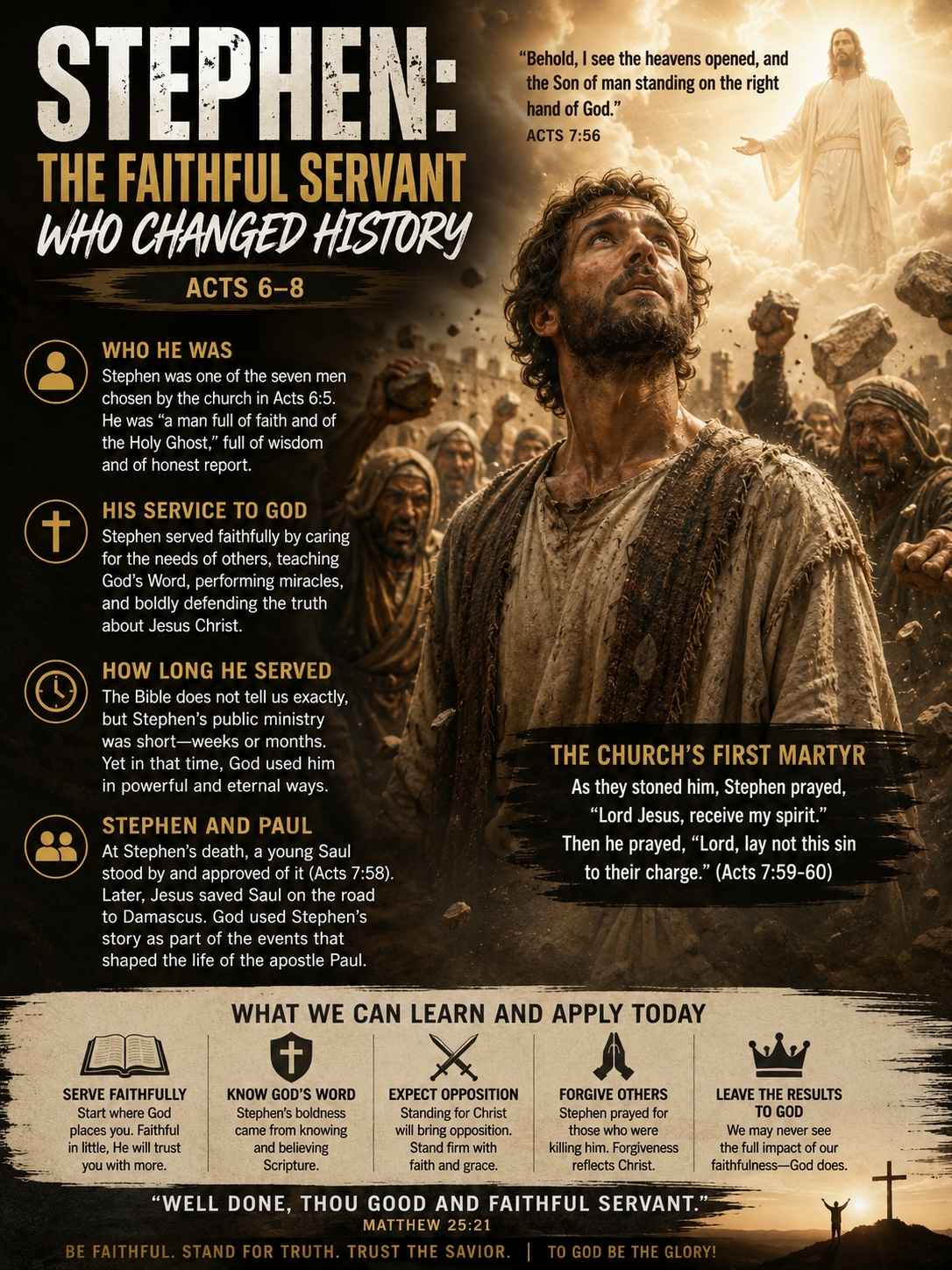
Stephen: The Faithful Servant Who Changed History
Stephen’s recorded ministry may have lasted only a short time, but his faithfulness, courage, knowledge of Scripture, and Christlike forgiveness left a lasting mark on the early church and on a young man named Saul.
Some people in Scripture served God publicly for many years. Others appeared for only a brief moment in the biblical record. Stephen was one of those whose recorded ministry was short, yet his influence reached far beyond his lifetime.
From the time Stephen is introduced in Acts 6 until his death in Acts 7, only a small portion of his life is recorded. The Bible does not tell us exactly how long he served in this public role. It may have been weeks or months rather than years, but Scripture does not give us enough information to establish a precise timeline.
Yet during that brief period, Stephen served the church, cared for people in need, defended the truth, preached one of the most important messages in the Book of Acts, became the first recorded Christian martyr, and left a testimony witnessed by the man who would later become the apostle Paul.
God Measures Faithfulness, Not Fame
God does not measure the value of our service only by its length, visibility, or worldly success. He calls us to be faithful with the time, opportunities, abilities, and responsibilities He gives us.
Who Was Stephen?
Stephen first appears in Acts 6 during a time of rapid growth in the church at Jerusalem. As the number of disciples increased, a complaint arose because certain widows were being overlooked in the daily distribution of food.
The apostles knew the problem needed attention, but they also understood that they could not neglect prayer and the ministry of the Word. They instructed the church to choose seven qualified men who could oversee this practical ministry.
Wherefore, brethren, look ye out among you seven men of honest report, full of the Holy Ghost and wisdom, whom we may appoint over this business.
Acts 6:3, KJVStephen was the first man named. Scripture describes him as “a man full of faith and of the Holy Ghost” in Acts 6:5.
Before Stephen became known as a preacher or martyr, he was known as a faithful servant. His first recorded responsibility was not standing before a large crowd. It was helping make sure vulnerable people within the church were properly cared for.
This teaches us that no work done for the Lord is insignificant. Serving meals, helping a widow, encouraging a struggling believer, cleaning a room, preparing a Bible lesson, visiting the sick, or quietly meeting someone’s need can all be sacred acts of Christian service when they are done faithfully for the glory of God.
Stephen’s Character Was His Greatest Qualification
The apostles did not tell the church to select the wealthiest, most popular, or most influential men. They were to choose men of honest report, full of the Holy Ghost, and full of wisdom.
Stephen possessed these qualifications. His usefulness did not begin with talent, education, or public recognition. It began with godly character, genuine faith, spiritual maturity, and submission to the Holy Spirit.
And Stephen, full of faith and power, did great wonders and miracles among the people.
Acts 6:8, KJVGod expanded Stephen’s ministry beyond the practical service he had first been given. The man who faithfully served the church was also empowered to speak, minister, and bear witness to Jesus Christ.
This does not mean that every faithful servant will receive a public ministry. It means believers should be faithful wherever God places them and trust Him with whatever opportunities follow.
Opposition Followed Stephen’s Faithfulness
As Stephen spoke about Christ, members of certain synagogues began disputing with him. They could not overcome the wisdom and spiritual power with which he spoke.
And they were not able to resist the wisdom and the spirit by which he spake.
Acts 6:10, KJVWhen they could not defeat his message honestly, they arranged for false witnesses to accuse him. Stephen was brought before the council and charged with speaking against Moses, the law, and the temple.
Faithfulness to Christ does not guarantee that everyone will approve of us. Christians are called to speak the truth in love, live honorably, and keep their conscience clear before God. The response of others belongs to the Lord.
Stephen’s Sermon in Acts 7
Acts 7 contains Stephen’s defense before the council. It is the longest recorded speech in the Book of Acts.
Stephen reviewed Israel’s history, beginning with Abraham and continuing through Joseph, Moses, the wilderness journey, the tabernacle, David, and Solomon.
This was not merely a history lesson. Stephen showed that Israel had repeatedly resisted God’s messengers. Joseph was rejected by his brothers. Moses was rejected by the people he came to deliver. The prophets were persecuted. Finally, Jesus Christ, the righteous Messiah, was betrayed and crucified.
Ye stiffnecked and uncircumcised in heart and ears, ye do always resist the Holy Ghost: as your fathers did, so do ye.
Acts 7:51, KJVStephen was not trying to win an argument for personal pride. He was bearing witness to the truth about Jesus Christ. He stood before powerful men and refused to change God’s message to protect himself.
Stephen Saw the Glory of God
The council became enraged by Stephen’s words. Yet while hatred surrounded him on earth, Stephen was given a glimpse of heaven.
But he, being full of the Holy Ghost, looked up stedfastly into heaven, and saw the glory of God, and Jesus standing on the right hand of God.
Acts 7:55, KJVBehold, I see the heavens opened, and the Son of man standing on the right hand of God.
Acts 7:56, KJVScripture often describes Jesus as seated at the right hand of the Father. Here Stephen saw Him standing. The text does not specifically explain why Christ was standing, so we should not be dogmatic beyond what Scripture reveals.
What we can say with certainty is that Jesus knew Stephen’s suffering. He had not abandoned His servant. Stephen’s enemies controlled what happened to his body, but they could not separate him from Christ or take away the eternal life he possessed through faith in Him.
Stephen Became the Church’s First Martyr
The crowd cast Stephen out of the city and stoned him. Even while suffering such cruelty, Stephen responded in a way that reflected his Savior.
And they stoned Stephen, calling upon God, and saying, Lord Jesus, receive my spirit.
Acts 7:59, KJVAnd he kneeled down, and cried with a loud voice, Lord, lay not this sin to their charge. And when he had said this, he fell asleep.
Acts 7:60, KJVStephen’s final words closely resemble the words Jesus spoke from the cross. He entrusted his spirit to the Lord and prayed for the forgiveness of those who were killing him.
This was not natural human strength. It was evidence of the grace of God and the work of the Holy Spirit within him.
How Long Did Stephen Serve?
Scripture Does Not Give an Exact Timeline
The Bible does not provide the exact length of Stephen’s service. We should therefore avoid claiming that he served for a specific number of days, weeks, months, or years.
His recorded public ministry appears brief. Acts introduces him in Jerusalem in chapter 6, records his arrest and sermon in chapter 7, and then describes the persecution that followed his death in chapter 8.
Although Stephen’s recorded ministry was short, God used him powerfully. In that time, he:
- Served people with practical needs.
- Helped protect the unity of the growing church.
- Demonstrated godly character and spiritual wisdom.
- Performed wonders and signs by God’s power.
- Defended the truth of the gospel.
- Preached a Scripture-filled message before the council.
- Became the first recorded Christian martyr.
- Left a testimony that was witnessed by Saul of Tarsus.
A long ministry can be a wonderful gift from God, but length alone does not determine faithfulness. Stephen’s life shows that God can use a brief season of obedience to accomplish something with eternal consequences.
Stephen and Saul, Who Became Paul
One of the most important details in Stephen’s story is the presence of a young man named Saul.
And the witnesses laid down their clothes at a young man’s feet, whose name was Saul.
Acts 7:58, KJVActs 8:1 tells us that Saul was consenting unto Stephen’s death. Saul was not an innocent observer. He approved of what was happening and soon became a fierce persecutor of the church.
Later, in Acts 9, the risen Lord Jesus confronted Saul on the road to Damascus. Saul was converted, commissioned by Christ, and eventually became known as the apostle Paul.
We should be careful not to claim more than Scripture says. The Bible does not state that Stephen’s sermon or death directly caused Paul’s conversion. Paul was saved by the grace of God through faith after his encounter with the risen Christ.
However, Scripture intentionally places Saul at Stephen’s death. Saul heard or witnessed Stephen’s testimony, saw his courage, and observed his Christlike forgiveness. Stephen’s story became part of the biblical background leading into Saul’s persecution of the church and his later conversion.
Stephen Never Saw What Saul Would Become
Stephen never saw Paul preach the gospel across the Roman world. He never saw the churches Paul helped establish. He never read the New Testament letters Paul would write under the inspiration of the Holy Spirit.
Stephen simply remained faithful in the moment God gave him.
Stephen’s Place in the Story of Acts
From Faithful Service to the Spread of the Gospel
The church selects seven spiritually qualified men to oversee a practical ministry need.
His Spirit-filled witness leads opponents to bring false accusations against him.
He uses Israel’s history to expose the people’s repeated rejection of God’s messengers and their rejection of Christ.
He sees Jesus standing at the right hand of God and dies while praying for his persecutors.
Believers carry the Word of God beyond Jerusalem into new communities.
The persecutor who approved Stephen’s death is confronted and converted by the risen Lord Jesus.
Why Is Stephen’s Story Included in Acts?
1. His Story Shows That Every Believer Can Serve God
Stephen was not one of the twelve apostles. Yet he was a faithful, Spirit-filled member of the church whom God used in a powerful way. Christian ministry is not limited to pastors, missionaries, or those with a public platform.
2. His Story Connects Service With Spiritual Character
Stephen’s practical ministry required honesty, wisdom, faith, and the filling of the Holy Spirit. The church should never treat service as merely filling a position. Biblical service flows from a believer’s walk with God.
3. His Story Explains the Spread of the Gospel
After Stephen’s death, persecution intensified. Believers were scattered from Jerusalem into Judea and Samaria.
Therefore they that were scattered abroad went every where preaching the word.
Acts 8:4, KJVThe enemies of the church intended to silence the gospel. Instead, the persecution helped carry the gospel into new regions, just as Jesus had said in Acts 1:8.
4. His Story Prepares Us for the Conversion of Saul
Stephen’s death introduces Saul as an opponent of Christ and His church. This makes Saul’s conversion in Acts 9 even more striking. The persecutor would become a preacher. The man who approved the death of a Christian witness would eventually suffer for bearing witness to the same Lord.
5. His Story Shows That Christ Remains With His People
Stephen’s circumstances were painful, but he was not abandoned. Christ was present, heaven was open, and Stephen’s eternal future was secure.
How Do We Apply Stephen’s Story to Our Lives?
Serve Faithfully
Do not wait for a large platform or important title. Begin with the need God has placed in front of you.
Develop Godly Character
Ability may open doors, but Christian character determines how we walk through them. Seek to be honest, wise, faithful, and Spirit-filled.
Know God’s Word
Stephen’s message was rooted in Scripture. Believers must read, study, believe, and obey the Bible so they are prepared to stand for truth.
Expect Opposition
Faithfulness to Christ will not always be welcomed. Stand firm without becoming hateful, proud, or bitter.
Forgive Others
Stephen prayed for those who killed him. Christ calls us to reject bitterness and extend the forgiveness we have received through Him.
Trust God With the Results
Stephen did not live to see how the gospel would spread after his death. Our responsibility is obedience. The outcome belongs to God.
Our Faithfulness May Influence Someone We Never Expect
We often want to see immediate evidence that our service matters. We want to know who was helped, what changed, and whether our labor made a difference.
Stephen’s story reminds us that we may never see the full impact of a faithful life on this side of eternity.
A child may remember a Sunday school lesson many years later. A struggling believer may remember a word of encouragement. An unbeliever may remember how a Christian responded during suffering. Someone who appears hostile to the gospel may later be saved by the grace of God.
We cannot convert anyone. Salvation belongs to the Lord. But we can live and speak as faithful witnesses, trusting God to use our testimony according to His sovereign purpose.
Stephen’s Story Points Us to Jesus
Stephen’s story should not end with admiration for Stephen. His courage, wisdom, forgiveness, and hope all point us to Jesus Christ.
Stephen served because Christ had saved him. He spoke because Christ is the truth. He forgave because Christ had forgiven him. He faced death with hope because the risen Christ was waiting for him.
The power of Stephen’s story is not that he was naturally fearless. The power of his story is that Jesus Christ was faithful to him, and the Holy Spirit enabled him to remain faithful to the end.
A Prayer for Faithful Service
Heavenly Father, thank You for preserving Stephen’s testimony in Your Word. Help us to serve faithfully wherever You place us. Fill us with wisdom, strengthen our faith, and help us stand firmly upon the truth of Scripture.
Keep us from pride, bitterness, and fear. Teach us to forgive those who wrong us and to trust You with the results of our obedience. May our lives point others to Jesus Christ, and may we remain faithful until our work on earth is complete.
In Jesus’ name, amen.
Be faithful. Stand for truth. Forgive others. Trust the Savior. Leave the results to God.