
Outdoor Crusade Bible Studies
The Parable of the Sower: What Kind of Soil Is Your Heart?
A Bible study of Matthew 13:1–23 and what Jesus taught about receiving, keeping, and obeying the Word of God.
One thing I appreciate about the way Jesus taught is that He often used things people saw in everyday life. He spoke about seeds, soil, trees, sheep, water, fishing, weather, farming, and harvests. He took something familiar from creation and used it to reveal a deeper spiritual truth.
The Parable of the Sower is one of the clearest examples.
Most of us understand that planting a seed does not guarantee a harvest. The seed may be good, but the condition of the soil determines whether it takes root, grows, and produces fruit.
Jesus used that picture to teach us about the condition of the human heart.
The Setting of the Parable
The Parable of the Sower is recorded in Matthew 13, Mark 4, and Luke 8. In Matthew’s account, Jesus went out of a house and sat by the Sea of Galilee. A large crowd gathered around Him, so He entered a boat and taught the people while they stood along the shoreline.
“And he spake many things unto them in parables, saying, Behold, a sower went forth to sow; And when he sowed, some seeds fell by the way side, and the fowls came and devoured them up: Some fell upon stony places, where they had not much earth: and forthwith they sprung up, because they had no deepness of earth: And when the sun was up, they were scorched; and because they had no root, they withered away. And some fell among thorns; and the thorns sprung up, and choked them: But other fell into good ground, and brought forth fruit, some an hundredfold, some sixtyfold, some thirtyfold. Who hath ears to hear, let him hear.”
Matthew 13:3–9
The people listening to Jesus would have understood this scene. Farmers often scattered seed by hand. As the seed was thrown, some landed on hard pathways, some on shallow rocky ground, some among thorns, and some in prepared soil.
The same seed reached four different kinds of ground, but the results were very different.
Jesus was not mainly teaching about farming. He was teaching about how people respond to the truth of God.
What Does the Seed Represent?
Jesus explained the meaning of the parable to His disciples. Matthew 13:19 identifies the seed as the word of the kingdom. Luke states it even more directly:
“Now the parable is this: The seed is the word of God.”
Luke 8:11
The seed represents God’s Word and the message of the gospel.
The problem in this parable is never the seed. God’s Word is true, powerful, and able to produce spiritual life.
“So shall my word be that goeth forth out of my mouth: it shall not return unto me void, but it shall accomplish that which I please.”
Isaiah 55:11
“For the word of God is quick, and powerful, and sharper than any twoedged sword.”
Hebrews 4:12
God’s Word is living and powerful. But when the truth is shared, people do not all respond to it in the same way.
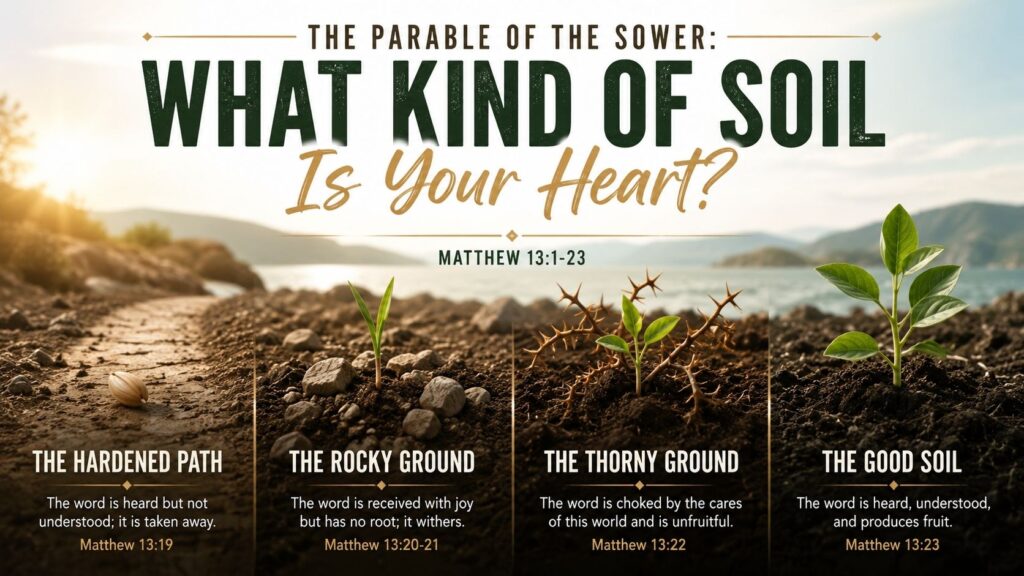
The four soils represent four conditions of the heart.
The Hardened Path
The Word is heard, but it does not enter the heart and is quickly taken away.
The Rocky Ground
The Word is received with excitement but has no deep root.
The Thorny Ground
The Word is crowded out by worry, wealth, distraction, and worldly desires.
The Good Soil
The Word is heard, understood, kept, and allowed to produce spiritual fruit.
1. The Hardened Path
“When any one heareth the word of the kingdom, and understandeth it not, then cometh the wicked one, and catcheth away that which was sown in his heart.”
Matthew 13:19
A pathway becomes hard because people repeatedly walk over it. The ground becomes so packed that a seed cannot get beneath the surface.
This represents a hardened heart.
A person with a hardened heart may hear the Bible preached, read Scripture, listen to Christian teaching, or hear someone share the gospel, but the truth never gets below the surface.
They may dismiss it immediately. They may be distracted, uninterested, skeptical, bitter, or unwilling to consider what God is saying.
The devil does not want God’s Word to take root. He works to distract people, confuse them, harden them, and keep them from understanding the truth.
“In whom the god of this world hath blinded the minds of them which believe not.”
2 Corinthians 4:4
A heart can also become hardened through repeated disobedience. Every time we recognize truth but refuse to respond, it becomes easier to ignore God the next time.
“To day if ye will hear his voice, harden not your hearts.”
Hebrews 3:15
We should never assume this warning applies only to other people. Even believers can become resistant in certain areas of life.
God may be speaking to us about forgiveness, pride, anger, our priorities, a sinful habit, or something He wants us to surrender. We can attend church, hear the message, and still refuse to let it change us.
The question is not only whether we heard the truth. The question is whether we received it.
Questions to Consider
- Have I become resistant to something God has repeatedly shown me?
- Do I listen to Scripture with a willingness to obey?
- Have disappointment, pain, pride, or sin hardened part of my heart?
- Am I allowing distractions to take God’s Word away before I think about it?
2. The Rocky Ground
“But he that received the seed into stony places, the same is he that heareth the word, and anon with joy receiveth it; Yet hath he not root in himself, but dureth for a while: for when tribulation or persecution ariseth because of the word, by and by he is offended.”
Matthew 13:20–21
This person responds quickly and emotionally. They hear the message and receive it with joy.
At first, everything appears promising. There is visible growth, excitement, and enthusiasm. But beneath the surface, there is very little soil.
The plant grows quickly because the soil is shallow, but it cannot develop a strong root system. When the sun rises and conditions become difficult, the plant withers.
Jesus said this represents someone who receives the Word but has no root. When hardship, pressure, opposition, or persecution comes, the person falls away.
This is a warning about a faith that depends entirely on emotion, convenience, or favorable circumstances.
“In the world ye shall have tribulation: but be of good cheer; I have overcome the world.”
John 16:33
Faith must become deeper than a temporary emotional response.
There will be days when we do not feel spiritually strong. There will be prayers that seem unanswered, circumstances we do not understand, and seasons when following Christ costs us something.
A deeply rooted faith remains because it is built on the truth of who Jesus is, not merely on how we feel.
“As ye have therefore received Christ Jesus the Lord, so walk ye in him: Rooted and built up in him, and stablished in the faith.”
Colossians 2:6–7
Roots grow beneath the surface where no one else can see them.
Our spiritual roots grow through prayer, Scripture, obedience, fellowship with other believers, and trusting God through difficulty. Public excitement cannot replace a private relationship with God.
Questions to Consider
- Is my faith rooted in Christ or mainly in my emotions?
- Do I only seek God when life is going well?
- How do I respond when obedience becomes difficult?
- Am I developing spiritual roots through prayer and Scripture?
- Do I know what I believe and why I believe it?
3. The Thorny Ground
“He also that received seed among the thorns is he that heareth the word; and the care of this world, and the deceitfulness of riches, choke the word, and he becometh unfruitful.”
Matthew 13:22
The seed in the thorny soil takes root and begins to grow. The problem is that other things are growing around it.
The thorns compete with the plant for sunlight, water, nutrients, and space. Eventually, they choke the healthy plant and prevent it from producing fruit.
Jesus identified two specific thorns:
- The cares of this world
- The deceitfulness of riches
Mark 4:19 also mentions the desires for other things entering in.
This may be the soil that many of us need to examine most carefully.
We live in a noisy world. Our attention is constantly pulled toward work, money, responsibilities, entertainment, social media, possessions, news, problems, and the expectations of other people.
Not everything competing for our attention is sinful. Work, family responsibilities, and planning for the future are necessary parts of life. But good things can still become spiritual thorns when they crowd God out.
Worry can consume our thoughts until we no longer trust God.
Money can quietly become the source of our security.
Busyness can make us feel productive while leaving us spiritually empty.
Entertainment can fill every quiet moment until we no longer sit still before God.
Possessions can demand our time, energy, and attention.
“Ye cannot serve God and mammon.”
Matthew 6:24
“But seek ye first the kingdom of God, and his righteousness; and all these things shall be added unto you.”
Matthew 6:33
The danger of thorns is that they may grow gradually. We may not notice the change immediately.
We do not wake up one morning and decide to become spiritually unfruitful. It happens as other things slowly take priority over prayer, Scripture, worship, service, and obedience.
The Word has not lost its power. It is being crowded out.
Questions to Consider
- What receives most of my attention each day?
- What do I think about when my mind is free?
- Has worry become stronger than my trust in God?
- Am I looking to money, possessions, or success for security?
- Is busyness preventing me from spending time with God?
- What may be choking spiritual growth in my life?
4. The Good Soil
“But he that received seed into the good ground is he that heareth the word, and understandeth it; which also beareth fruit.”
Matthew 13:23
The good soil represents someone who hears God’s Word, understands it, receives it, holds onto it, and allows it to produce fruit.
“But that on the good ground are they, which in an honest and good heart, having heard the word, keep it, and bring forth fruit with patience.”
Luke 8:15
Good soil does not merely hear the Word. It keeps the Word.
This person allows God’s truth to move from the ears into the heart and then into everyday life.
“But be ye doers of the word, and not hearers only, deceiving your own selves.”
James 1:22
The evidence of good soil is fruit.
Fruit does not save us. We are saved by grace through faith in Jesus Christ. However, a genuine relationship with Christ should begin producing visible changes in our lives.
“But the fruit of the Spirit is love, joy, peace, longsuffering, gentleness, goodness, faith, meekness, temperance.”
Galatians 5:22–23
Spiritual fruit may also include obedience, generosity, forgiveness, service, sharing the gospel, helping others, and becoming more like Christ.
Not every plant produces the same amount. Jesus said some produced a hundredfold, some sixtyfold, and some thirtyfold.
We should not compare our spiritual growth with someone else’s. Our responsibility is to remain faithful and allow God to produce the fruit He desires in our lives.
Fruit also takes time.
A farmer does not plant a seed in the morning and expect a full harvest by the afternoon. The seed must remain in the soil. It must receive water, sunlight, and time.
Spiritual growth also requires patience. We keep reading. We keep praying. We keep obeying. We keep trusting God even when growth feels slow.
The Condition of Our Hearts Can Change
Soil can be worked.
Hard ground can be broken.
Rocks can be removed.
Thorns can be pulled.
Neglected soil can be prepared.
That gives me hope.
We may recognize hardness, shallowness, distraction, or spiritual neglect in our lives. But we do not have to remain that way.
We can come honestly before God and ask Him to work in us.
“Search me, O God, and know my heart: try me, and know my thoughts: And see if there be any wicked way in me, and lead me in the way everlasting.”
Psalm 139:23–24
We cannot change our hearts through willpower alone. We need God’s grace, His Word, and the work of the Holy Spirit.
But we must also be willing to respond.
We may need to confess sin, forgive someone, change a habit, remove a distraction, ask for help, spend more time in Scripture, or obey something God has already made clear.
Preparing the soil of the heart requires honesty.
Hearing Is Not the Same as Receiving
“Who hath ears to hear, let him hear.”
Matthew 13:9
Everyone in the crowd physically heard the same words, but not everyone received them in the same way.
It is possible to listen to sermons for years without allowing God’s Word to change us.
It is possible to read the Bible while remaining distracted.
It is possible to know many verses while refusing to obey them.
Spiritual maturity is not measured only by how much Scripture we have heard. It is also revealed by how faithfully we respond to what we have heard.
“Blessed are they that hear the word of God, and keep it.”
Luke 11:28
God does not give us His Word merely to increase our knowledge. He gives us His Word to reveal Himself, draw us to Christ, correct our thinking, guide our decisions, and transform our lives.
Examine the Soil
The Parable of the Sower should cause each of us to examine our own heart.
We should not immediately decide which kind of soil describes someone else. We should ask God to show us what is happening within us.
Ask Yourself
- Is my heart hardened?
- Is my faith shallow?
- Is my spiritual life being choked by worry, money, busyness, or distraction?
- Am I receiving God’s Word and allowing it to produce fruit?
“Examine yourselves, whether ye be in the faith.”
2 Corinthians 13:5
This kind of examination is not meant to leave us without hope. It is meant to draw us closer to Christ.
When God reveals something unhealthy in the soil of our hearts, He is giving us an opportunity to respond.
How to Prepare Your Heart for God’s Word
- Pray for understanding. Ask the Holy Spirit to help you understand what you are reading.
- Remove distractions. Put the phone away, turn off unnecessary noise, and give God your full attention.
- Read slowly. Pay attention to repeated words, commands, promises, warnings, and truths about God.
- Ask what the passage means. Consider who wrote it, who received it, what was happening, and what truth it teaches.
- Ask how it applies. Look for a command to obey, a sin to confess, a promise to trust, or an example to follow.
- Respond with obedience. Do not stop at understanding. Take the next faithful step.
“Open thou mine eyes, that I may behold wondrous things out of thy law.”
Psalm 119:18
“If ye love me, keep my commandments.”
John 14:15
What Kind of Soil Is Your Heart?
The seed of God’s Word is still being scattered.
The truth is still being preached.
The gospel is still being shared.
God is still calling people to repent, believe, follow Christ, and produce spiritual fruit.
The question is not whether the seed is good.
The question is whether our hearts are ready to receive it.
My prayer is that we will not be satisfied with merely hearing God’s Word. I pray that we will receive it, hold onto it, obey it, and allow God to produce lasting fruit through our lives.
Let us ask God to break up the hard ground, remove the rocks, pull out the thorns, and prepare our hearts.
Then, when His Word is planted within us, may it grow deeply and produce a harvest that brings glory to Him.
“But be ye doers of the word, and not hearers only.”
James 1:22